
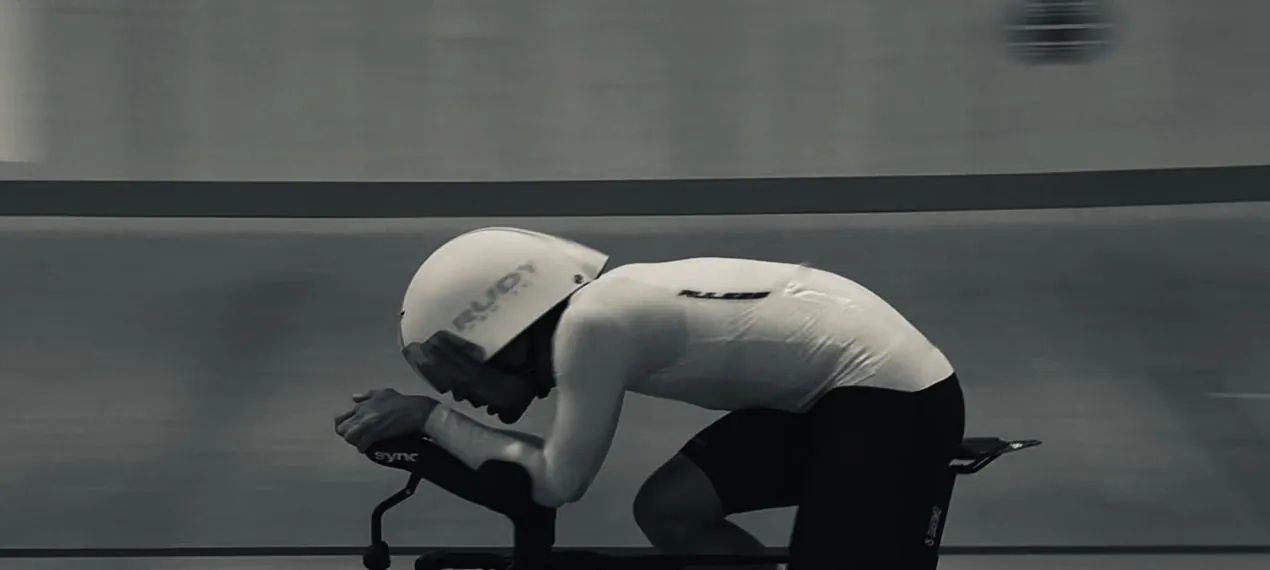
My trusty Colnago TT1 is the longest running TT platform I have ever used, as it is now heading into its third consecutive season. A lot has changed since I first started using this bike back in early 2024. TT equipment, and cycling technology are moving on at a rapid pace, which resulted in an almost wholesale change on the componentry that I now use.
In my years of racing and aero-testing riders, I have learned that it is simply not possible to out-train an inefficient TT setup. The numbers do not lie: back in 2017-2018, when I started doing TTs, I could average a measly 46km/h on a fast course with a threshold of around 300W. Fast forward to today`s technology, and that number is close to 51km/h – basically a 10% difference in speed for the same power.
The journey is never quite finished though, as I am constantly tinkering and looking for ways to increase efficiency and go faster.
This year is no different of course, and together with my amazing suppliers I was able to eke out a few more gains, pushing my drag numbers to an area that I frankly did not believe to be possible. Obviously, this helps me in my own racing, but more importantly, I can transfer this knowledge to real world gains for my customers as well.
Of course, at my stage of equipment optimization, the low-hanging fruit is long gone. That said, there are always some areas for possible improvements if you look (and think) hard enough.
Here is what we have done for this season:
The basebar is an often overlooked aspect of a TT setup. What makes matters worse is the fact that most brands specify a pointlessly wide bar on even their latest bikes – with the exception of Pinarello and their Bolide F TT.
Not going to lie, that is exactly the bike I took inspiration from and decided replicate the incredibly narrow (360mm e-e) basebar on my Colnago TT1.
With the help of our manufacturing partner Fibenta, this has been easier than expected (honestly, I dont know why I haven`t thought about this earlier.
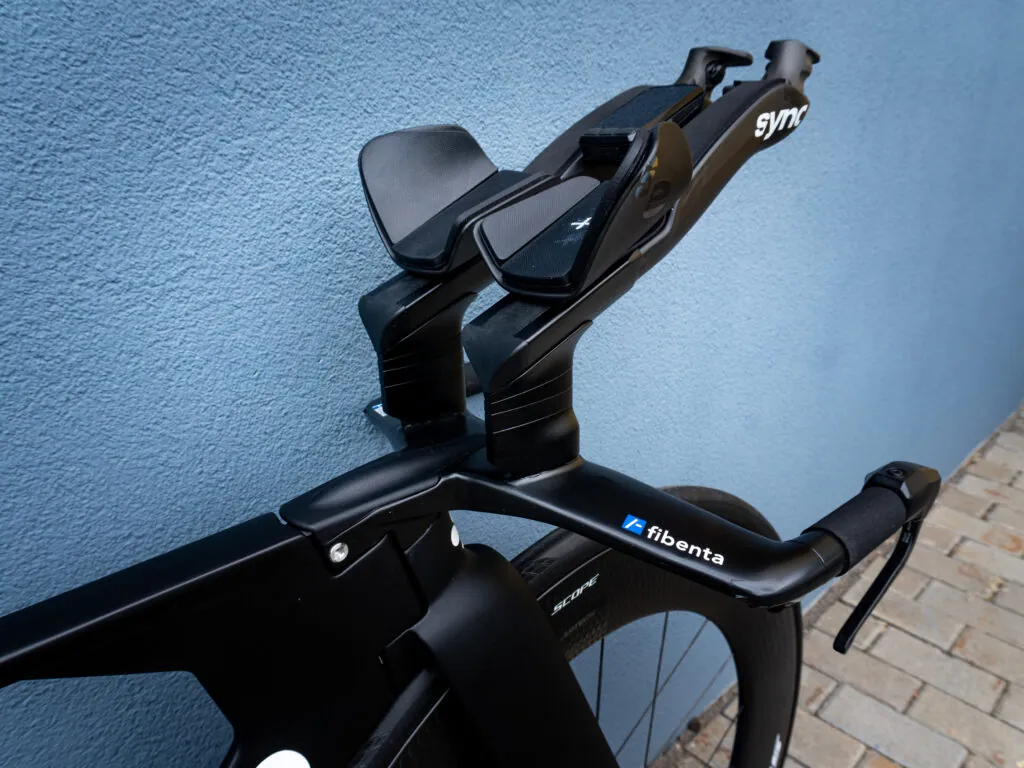
For technical reasons, it is not possible to verify the exact CdA difference between the two basebars, as the swap requires a full bike rebuild. However, as the bar directly influences the frontal area without much systemic interaction, it is quite a safe bet to predict some level of drag reduction.
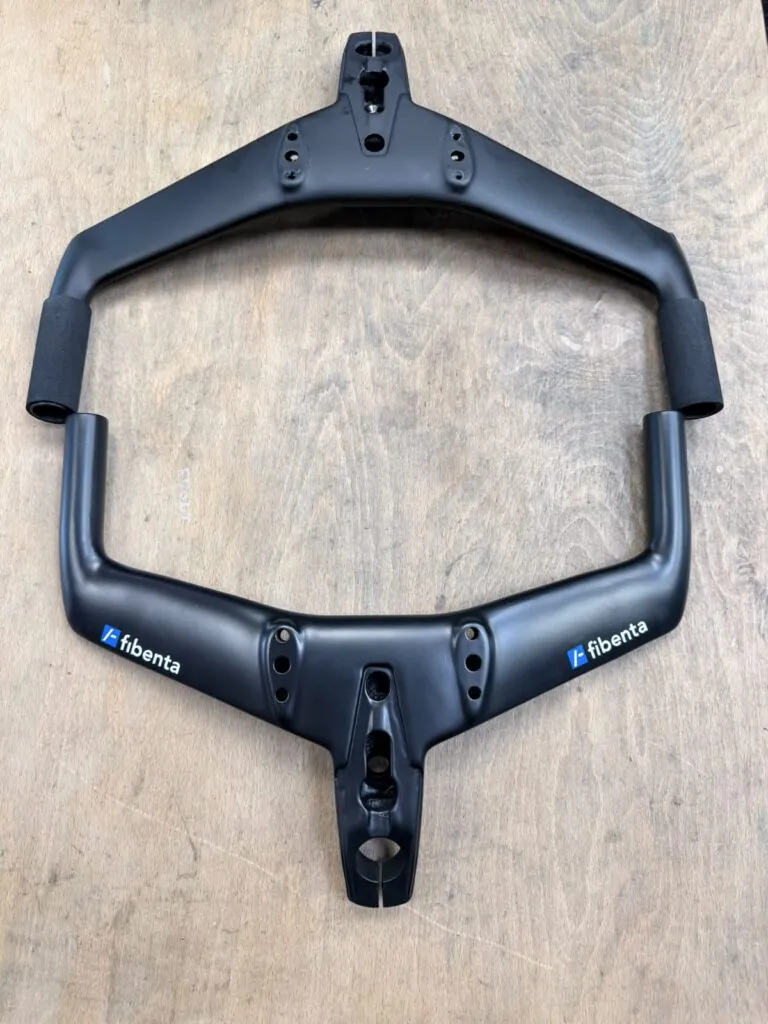
The closest estimation I can make is the comparison with my last baseline CdA of 0.158m2 to the new baseline measurement of 0.153m2. Given the similarity of conditions between the measurements, I am quite confident in that value. The resulting power saving is roughly 9W at 50km/h. Very impressive indeed for such a seemingly simple swap.
You can get a narrow basebar for your own TT1 (or potentially other bikes) here.
Full finger aero gloves are definitely not something you want to wear in hot conditions (like at the TT Nationals), but I was curious about their performance so could potentially use them in cooler events. On the track, they are particularly handy, as they provide excellent grip on the aerobar.
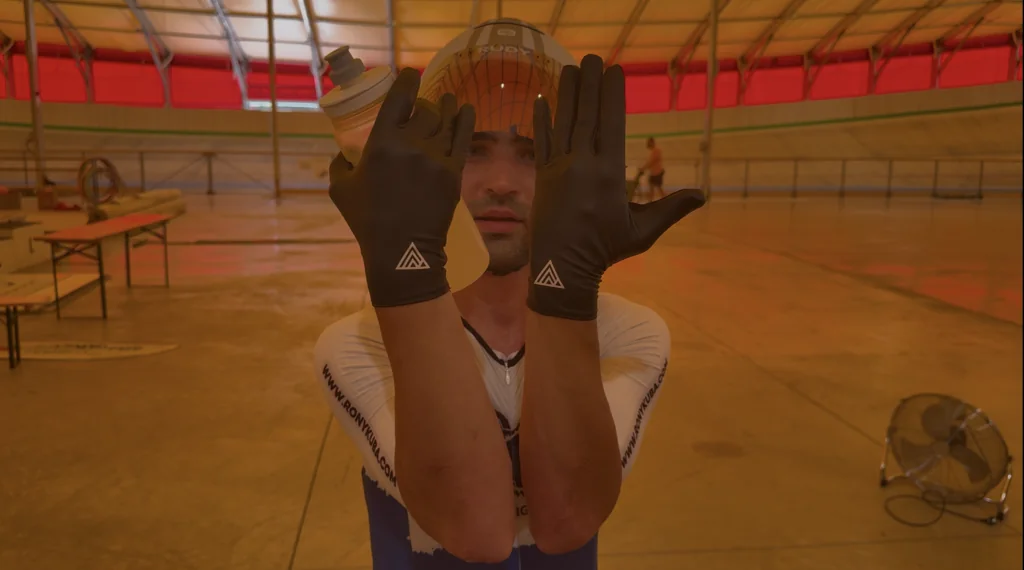
I did test the earlier version of these back in 2019, when there was a slight aero penalty, so I did not end up using them much. Based on this experience, I did not have much of an expectation, but surprisingly there was a slight drag reduction to be had.

Of course, the drag reduction is nothing to write home about. It is not worth the cooling penalty in hot conditions. However, it is good to know that there is no penalty for wearing them when the weather gets cool and there can even be a slight advantage.
When I started working with Rule28 back in 2023, their aero overshoes were far from perfect. The release of the new NEO overshoes brought a huge improvement in overall fit and of course the fact that these finally stay on properly. Needless to say, this brought the respective CdA improvements as well.
Last year, I did test the NEOs against a variety of options, and they did come out on top as expected. However, since I am using S-Works Torch Lace-up shoes (which have an incredibly smooth overall profile), I was toying with the idea of riding these uncovered.
To make for a fair comparison, I have ordered a pair of the new NEO Aero socks as well.
As an added bonus, I have added a pair of the long, non-UCI complaint NEO Overshoes as well, just to spice things up.
Now again, I did not have huge expectations from this experiment, but it turned out to be more than worthvile.
The NEO socks on their own matched the overshoes in terms of drag, which was quite a surprise. The best thing about that is the cooling bonus which this provides, relative to my feet sous-vide when riding in overshoes.
After this run, I have put on also the Warp Sleeves to cover up my laces, which turned out to be the fastest combination available.
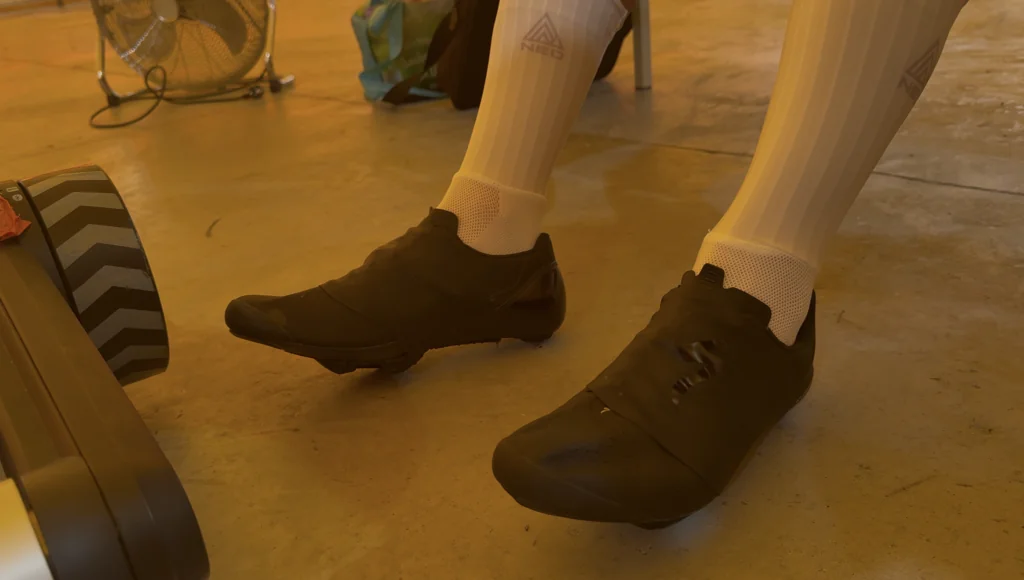
The long non-UCI overshoes were a bit of a disappointment, as there was no improvement whatsoever. Not to mention the fact that they are much bulkier, hotter and less comfortable than any other option. Yet again, UCI legal did not mean slower.

Another thing I have been looking to test for a while is the placement of a pouch on the front of the skinsuit. The Rule28 Cargo Base Layer is an excellent tool to test this out.
We have tested various configurations and “fill rates” in my session, but the results were quite erratic. The filled pouch pushed the edge of the skinsuit away from my chest, creating an air pocket. This caused buffeting and unreliable runs. Too risky to try in race conditions.
What did work though, is a minimal fill with flatter objects. This means I can carry some piece of equipment in there without risking an aero penalty – ideal for an ice sock in hot conditions. It is also great for carrying my phone during training on the TT bike, instead of having it in my rear pocket. Much more comfortable.
Time trials have been dominated by long sleeve suits for decades thanks to the common adage – “Modern materials are faster than bare skin.”
This trend has been de-bunked somewhat, by no other than 3x TT World Champ Remco Evenepoel. I have also used a few short sleeve TT suits over the years (notably also during my 2021 victory in the ITT Nationals). I did this primarily due to cooling reasons, as the Nationals are often held during the hottest period of the year.
However, I also had some good test results with them, so this time I wanted to put this topic to rest once and for all.
Obviously, we needed to make a fair comparison, so I tested a stock long-sleeve NEO suit against my own, cut-down version.
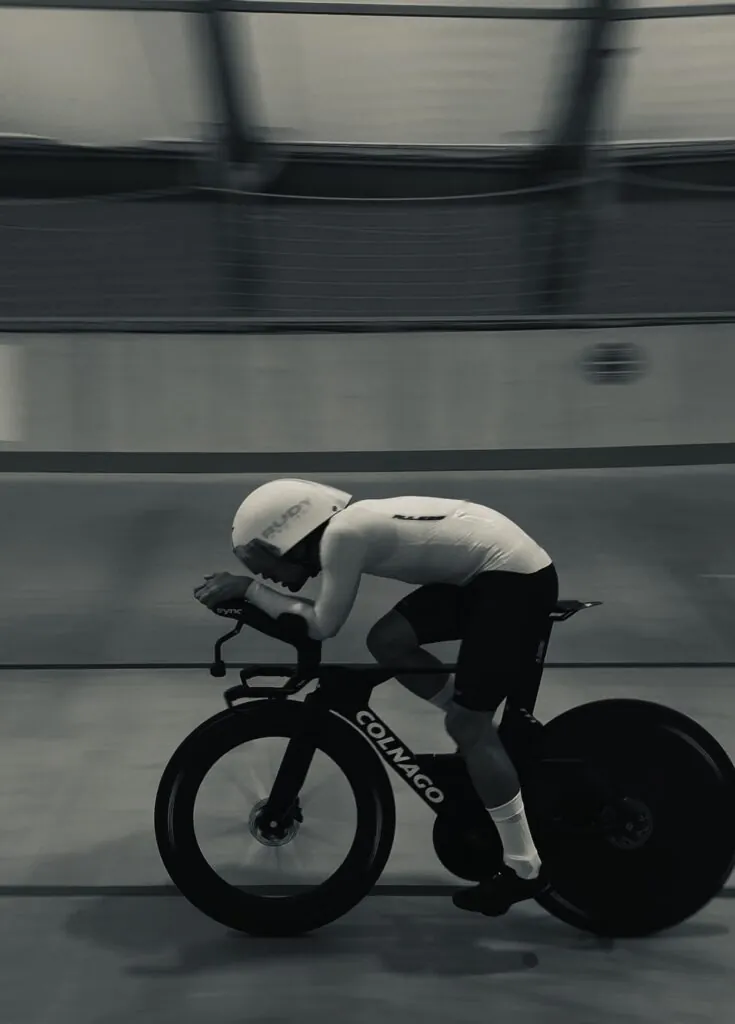
No surprises here when it comes to the results. The short sleeve suit was ever-so-slightly faster, so with the added cooling this really is a no-brainer.

Aerobars/extensions can have a massive impact on your aerodynamic performance. For the past year or so, we have been getting extremely good results for our clients with the new SYNC AB3, so naturally I was curious to try it out for myself.
On paper, this might seem like a downgrade compared to my custom 3D printed Speeco cockpit, but the opposite turned out to be true.
When adjusted to match my position 1:1, the AB3 surprisingly edged out the Speecos by 4.4W (@50km/h). That is not a massive saving, but by all means significant.
It gets even better when you consider the fact that the AB3 is still a fully modular and adjustable system. Within minutes, you can alter the tilt, reach, stack and even the armrest and pole width. It also does come with an extremely neat computer mount (combined with a GoPro mount if needed). The hooked grips are also much more secure and comfortable than I had on the Speecos.
In short, I am sold. The only real downside I can mention is that they are around 100g heavier in total. The foam on the arm pads is also a bit firm, but I got used to that within a few rides.
Needless to say, the AB3s will remain my number one recommendation for clients at this time.
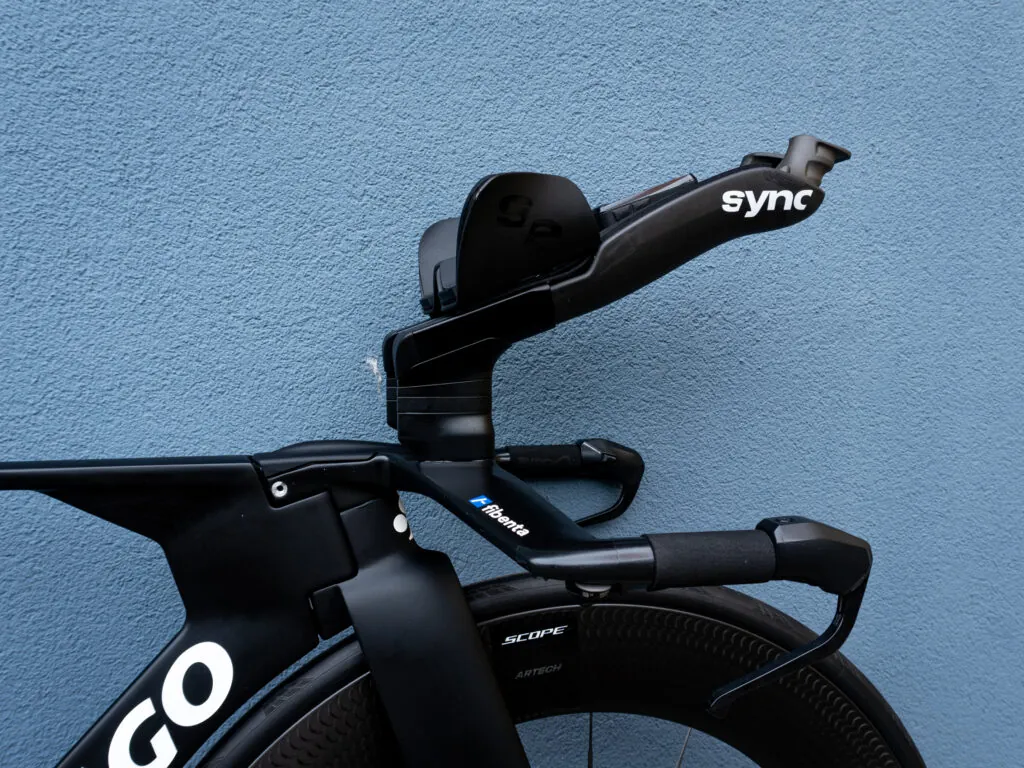
In the end, we increased my stack height by 10mm. This has improved my comfort and field of view, with a very minimal aero penalty (1.5W @50km/h). It is a compromise that I am more than happy to make, given that both my A-events will be ~1h long TTs.
Last year, I have already done some testing of various crank lengths, thanks to my Wattshop Cratus adjustable aero cranks. With the long arm version, I was able to test all the relatively common lengths. Out of 170, 165 and 160mm options, I went for the shortest one. It was not only the fastest in terms of CdA, but also the best regarding comfort and power production.
For a variety of reasons, I made the switch to SRM PM9 power meters this year. This allowed me to get the short arm version of the updated Mk2 Cratus arms, knowing very well that I am not likely to use anything longer than 160mm anymore.
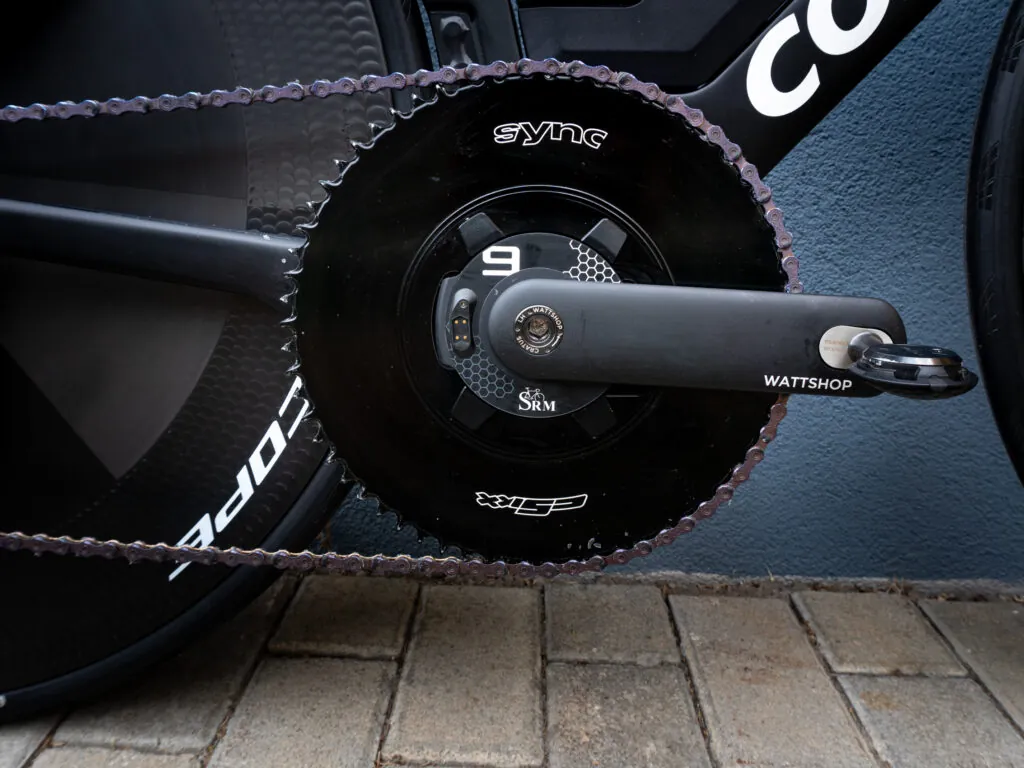
Going below 160mm is definitely an unknown territory for me. In my test, I first went with 155mm. This length did not produce any real difference in CdA, but the power delivery felt better. I found it easier to get on top of the stroke in threshold efforts.
Things started feeling weird at 150mm, with no CdA benefit, so I stuck with 155mm at first. Later in training, I have noticed increased saddle pressure, which is a clear sign of the cranks being too short.
To compensate for this, I split the difference using the Wattshop inserts and settled for 157.5mm. This still improves the pedaling feel on the top of the stroke, without compromising saddle comfort.
The results of this test session confirm two of my theories:
1.) The technology is constantly evolving, so it is always possible to find newer and newer improvements. If you don`t invest in that, you get left behind.
2.) Chasing the lowest CdA is not everything. Thanks to the equipment choices mentioned here, I was able to arrive at solutions that improve my cooling and comfort. All this while providing small drag reductions at the same time – making me faster in the long run.
Of course, I would love to say that my options are now exhausted for a while and I don`t need to think about improving it, but unfortunately that is not the case.
There still are at least two options that I would like to test later this year.
The first of them is quite obvious. I am getting a large number of queries regarding the new Pirelli SL-R tires. Based on initial wind tunnel and rolling resistance tests, we can`t expect a dramatic speed boost from them. Nevertheless, it looks like they could increase the crosswind stability quite significantly, with not much penalty whatsoever. That is an interesting prospect in my mind.
The second thing (likely more substantial) is the reach of the SYNC AB3. At the moment, we have cut the bars to mimic my previous reach on the Speecos. There is an option though of going 10mm shorter. We have already cut the extensions to the minimum length in the meantime.
Overall, I am really happy with the changes we have made. It is definitely a nice confidence boost heading into the Nationals.
It is also important to note that this level of performance and optimization IS NOT POSSIBLE without access to velodrome aero testing. If you are inspired by this never ending process, you can book a test session with us HERE.
2 Responses
Greetings, I am interested in the fibenta handlebar for my specialized shiv, could you help me?
Hi. Yes, I can.