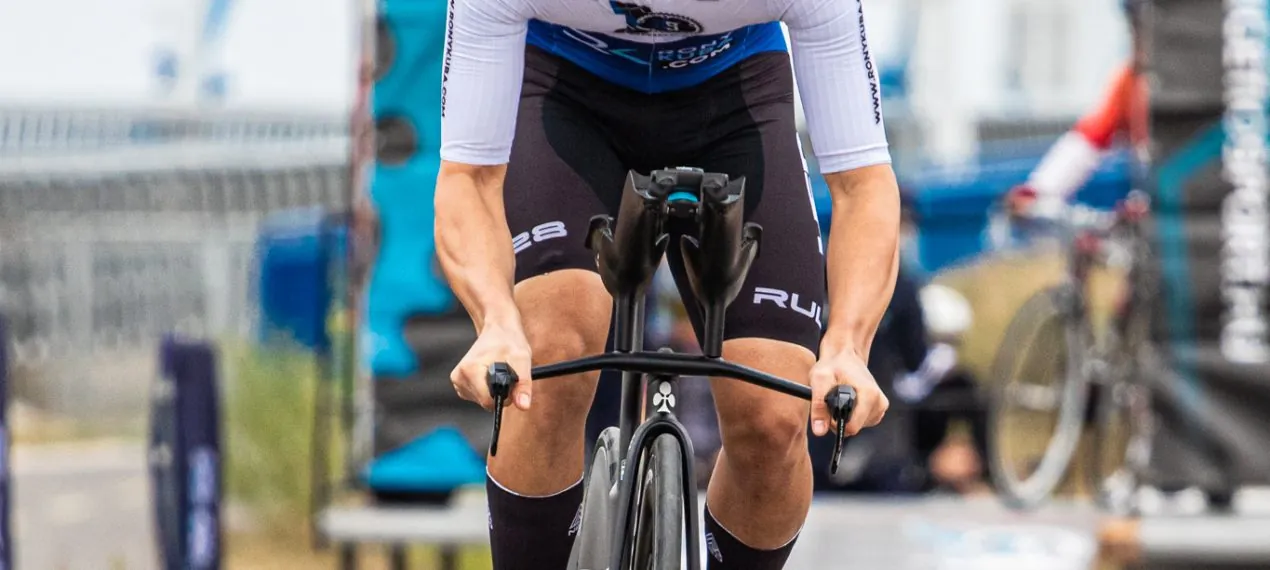
Check out or latest addition to the product line-up: CYBREI Cranks and components!
‘’You need to try a bunch of different saddles to see what works best for you”.
No, you really don`t. In 90% of the cases, the cause of saddle sores is a bad position, not the saddle itself. Yes, there are saddles that have a good (or bad) design in general – and some of these will be more suitable than others due to their features.
The truth is though, if you have a decently dialled fit on your bike, with the correct cleat setup, saddle position and handlebar stack/reach, you will find that most properly designed saddles work just fine.
…so, before you go ahead and decide to randomly order 10 different saddles to “test” them, just make sure to invest in a quality bikefit first.
It is going to be much cheaper in the long run, and you will be surprised how well can you get on with a saddle that was uncomfortable earlier.
Sometimes yes… but also often no. The cycling media loves to oversimplify this topic, so let`s clear the confusion.
Rolling resistance is made up of two components: hysteretic losses and suspension losses. As your tire revolves, it periodically forms a contact patch at the ground, where it deforms. The energy lost during this deformation is the hysteretic loss. A stiffer tire produces less hysteretic loss, as it deforms less. You can increase the stiffness by increasing the pressure and/or the VOLUME of the tire.
Even the smoothest looking surface has tiny undulations that cause your bike + rider system to vibrate. If your tires are too stiff, they can’t absorb these vibrations. These will then be transformed to your bike and body, leading to suspension losses.
Now, if you understand these mechanisms, it is easy to see that the fastest tire pressure for a given scenario will greatly depend on the roughness of the surface you are riding on, and will need to balance two contradictory requirements.
As a result, tire pressure will always be about finding a compromise, as maximising or minimising are both wrong. However, we know from tests that there is a smaller penalty for going slightly too low, so err on the low side!
To get a pressure baseline for a given setup, we always use the proven Silca Tire Pressure Calculator.
In practice, not so much. In any given moment, your speed is limited, AND determined by the resisting forces you are experiencing (aero drag, rolling resistance, mechanical losses, gravity).
What your gear ratio determines is the cadence you have to pedal at that exact point in time.
While your ratios can be limited, your cadence isn`t. A high-level rider can achieve and sustain a cadence of 180-200RPM, so their theoretical top speed is extremely high, even when using relatively short gear ratios. There are also riders that can tolerate very low cadences on climbs, riding as low as 50-60 RPM.
Hence, your gear ratios can only limit your speed if they are so far off optimal that they push you outside of your preferred cadence at given circumstances.
This really can`t be further from the truth. The UCI has no magic wand, and the rules really can`t shape fluid dynamics. The dimension restrictions that they apply are mostly arbitrary, and are based in traditional bike designs – something which they are used to preserve.
While some aspects may indeed directly limit aerodynamic performance, they do not always align with break points in performance.
Nevertheless, creating a fast bike is not as simple as applying massive airfoils and hoping for the best.
To be successful, you have to carefully balance pressure drag and skin drag, while also ensuring good flow interactions between the moving components of the system – mainly the rider and wheels.
Unfortunately, the reality is a bit more complicated than that.
Quite often the positions with the best CdA for a given rider falls well into the limits mandated by the UCI. Nowadays it is really easy to fall into the trap of various trends (extra-long reach for example), but you have to remember, that the interactions in aerodynamics are really complex and un-intuitive:
What works for some, might not works for you. What looks good, might not necessarily be fast.
The only guaranteed way to improve your aerodynamics is to test – and test everything.
This seems to be a common trend and misconception in triathlon these days, but unfortunately it does not really stand up to scrutiny.
The parameters that ultimately influence your hip angle the most are: saddle setback and height, crank length, cleat position and front end stack height. Reach in itself does not have much of an influence unless combined with some of these other elements.
A lot of people seem to be adding reach extenders to their bikes to compensate for an overly forward saddle position. This however is not optimal, as a lack of setback overloads the quad muscles, penalizing you in the long run.
One upside that long reach has is that it can make it easier to add front hydration to your setup. Otherwise, it is often a significant aero penalty as well.
False. The shorter the event, the higher the relative intensity that it is ridden at.
Hence, a short, intense effort requires a position that allows for good power production that often sacrifices a bit of aerodynamic efficiency – to make the rider faster overall.
Comfort is a relative term. A few mms of stack/reach/pad width etc. will make next to no difference to a rider´s ability to ride for a long duration, but it might have a big impact on the final CdA.
On the other hand, power production is not a high priority when riding at 70-80% of FTP, so riders can actually tend towards the more aerodynamically efficient positions.
Unfortunately, it is not as simple as that. In cycling, and particularly position, there are very few (if any at all) parameters, which you want to maximise or minimise. Almost every single one of them has an optimum, where you find a breaking point in both ways.
That is also why it is almost impossible to achieve your best possible position without rigorously aero testing everything.
Rule of thumb simply does not cut it, and every untested position change can potentially ruin your efficiency!
At face value, it might look like a big initial investment. However, the costs pale in comparison to what you potentially stand to lose when you work months (maybe years), just to not meet your goals at your target event or maybe never realise your true performance potential.
Not to mention the losses associated with all the useless sub-optimal equipment that people buy without validation to seek non-existent performance improvements.
Yes, adding the cost of renting a velodrome does increase the hourly expenses compared to testing outdoors. However, you need to account for the fact that the testing process itself is much quicker and more streamlined.
An outdoor test run takes 12-14min even for a fast rider. The velodrome equivalent will not take longer than 5min.
Plus, there is no risk of changing weather conditions, which lead to the need of re-testing and repeated calibration runs when testing outdoors.
Well, you can`t really know that unless you have tested every combination of frames, components, riders and positions available. (IMPOSSIBLE)
“The fastest bike is fastest?” is a question that I get asked quite often. With tires, chain lubricants and drivetrain components, it is relatively simple. The performance here is mostly one dimensional, and there is a body of independent test data that makes it easy to pick the best performers.
However, things are not at all straightforward when it comes to aerodynamics – as each component interacts with every other component.
For this reason, it is difficult to claim that one particular frame, handlebar or wheelset is THE FASTEST, as there are likely multiple combinations of components and positions to achieve similar performance. I have ridden a few TT bikes over the years, and the CdA numbers always converge to a similar value.
In short, the effect of testing and finding the optimal adjustment window of a given setup is much larger than changing to different components.
This concept is a bit of a relic from the past, but many cyclists still fantasize about bringing their bike weight down to minimum, with the intent of making themselves climb, or ride faster. In practice however, this usually is not an effective strategy at all.
The first problem is, that apart from steep gradients, the total system weight is rarely the thing that would be responsible for the majority of the resistive forces that we encounter while riding.
Secondly, the bike weight itself is rarely more than 10% of said system weight, and the difference between a “very light” or a “very heavy” bike is usually not more than 25-30% of that. Basically, we are talking about a 1-3% system weight difference at best.
The final, and biggest problem with this in my mind is that replacing components with lightweight variants usually compromises some other aspect of performance, particularly in aerodynamics. Despite being a small part of the overall mass, they can be a significant portion of the overall drag.
Lightweight, round tubed frames, handlebars and stems are way less aerodynamic, making for a huge aerodynamic penalty. Tubular tires and wheels are lighter, but have a higher rolling resistance compared to more modern options.
In practice, the weight savings of these parts can never make up for the efficiency lost elsewhere.
HOWEVER, saving weight in areas of your bike/equipment, that have no effect on the aerodynamic efficiency, rolling resistance or drivetrain efficiency yield a SMALL, BUT GUARANTEED performance improvement.
This is another very common misconception that is not rooted in reality very firmly, and there are two major problems that I can point out in it.
Now, everyone is familiar with the non-linear nature of aerodynamic drag in power terms. Yes, a doubling in speed means you need to produce eight times the power to overcome the drag, that is all well and good.
On a flat road, air resistance becomes your largest resisting force almost immediately, at around 18km/h in my case, when it equals out with rolling resistance. From there on it rises rapidly to become 80-90% of the total resistance at normal riding speeds.
This means that literally everyone is getting a huge benefit, regardless of their speed, as they are cutting away from the biggest part of the resistance. Yes, due to the non-linearity, the wattage savings do not look impressive at all at lower speeds, but you need to consider these in relative terms, as it is a significant percentage of the drag. The time saved is actually much greater for a rider travelling slower, as he spends more time on the course overall.
What people often don´t realise is the effect of the gradient. This can shift the distribution of the total drag significantly. Even at a relatively shallow 2%, you have to go up to 42km/h in order for aero drag to become the largest resistive force. At 4%, this breakaway point goes beyond 60km/h, which is not a realistic cycling scenario anymore.
The real question then is not the speed, much rather the gradient at which aero is still the most important!
This is a surprisingly common misconception, but it is not that valid if you think about it for a little bit. If we strictly talk about “pushing” this gear, you have to take the whole ratio into consideration:
e.g. :The front chainring is a 58t, while the cassette is an 11-30.
If you take the shortest ratio, the 58×30, you can ride at a leisurely pace of 20km/h at a comfortable cadence of 80rpm. That is certainly achievable for even a beginner cyclist on a flat road. So, by this account, literally everyone can “push” this gear.
If we talk about optimisation however, the situation is a bit different though. This kind of gearing is optimised for an average speed of around 45-50km/h, where the chainline would be the most efficient. Now this is not something that can be reasonably expected from a novice rider. Not to mention if there is some climbing involved.
So, to “push” this gear? Yes, almost anyone can do that. To use it optimally though, that is a different story.